Showing posts with label Northern California. Show all posts

Why Consulting a Valve Expert Is Essential for Process Control Success

Why Consulting a Valve Expert Is Essential for Process Control Success

Designing process control systems that require industrial control valves demands a high level of expertise and precision. Industrial control valves play a pivotal role in regulating flow, pressure, temperature, and fluid levels within various industrial processes. Any misstep in their selection or implementation can lead to inefficient operations, safety hazards, and increased costs. Therefore, consulting with an experienced process control valve expert becomes not just beneficial but critical in ensuring the success and safety of these systems.

Industrial control valves come in an array of types, materials, sizes, and specifications. Each valve must meet the specific demands of the process conditions it will encounter, such as temperature extremes, corrosive substances, or high-pressure environments. An experienced valve expert possesses in-depth knowledge of these variables and understands how they interact within a complex system. They can navigate the intricate details a general engineer might overlook, ensuring that the selected valves align perfectly with the system's requirements.

Moreover, valve experts stay abreast of the latest technological advancements and industry standards. They bring insights into new materials, designs, and control technologies that can enhance system performance. By leveraging their expertise, they can recommend valves that meet current needs and offer scalability and adaptability for future process changes. This forward-thinking approach can save time and resources in the long run, preventing the need for costly overhauls or replacements down the line.

The financial implications of improper valve selection or implementation are significant. Incorrect valves can lead to leaks, equipment damage, or system failures, resulting in unplanned downtime and repair costs. An experienced valve expert can mitigate these risks by ensuring that every valve is suited to its specific function and environment. They can conduct thorough assessments and simulations to predict how valves will perform under various conditions, thereby preventing potential issues before they arise.

Safety is another paramount concern in industrial processes. Valves not appropriately selected or maintained can pose serious safety risks, including explosions, fires, or exposure to hazardous substances. Valve experts understand the critical safety standards and regulations that govern industrial operations. They ensure that all valves comply with these standards, providing peace of mind that the system operates safely and efficiently. Their expertise can also contribute to a safer work environment by reducing the likelihood of accidents caused by valve failures.

In addition, collaborating with a valve expert fosters better communication and understanding among the engineering team. These experts can bridge gaps between disciplines, ensuring that mechanical, electrical, and control systems work harmoniously. They can provide valuable training and support to the team, enhancing overall competency and confidence in managing the control system.

Time efficiency is yet another benefit of involving a valve expert. Designing and implementing control systems is a time-sensitive endeavor, and any delays can have cascading effects on project timelines and budgets. Valve experts streamline the selection and implementation process, making informed decisions quickly and accurately. Their experience allows them to anticipate and address challenges proactively, keeping the project on schedule.

The complexity and critical nature of industrial control valves necessitate the involvement of an experienced process control valve expert in the design of process control systems. Their specialized knowledge ensures optimal valve selection, enhances system performance, reduces financial risks, and upholds safety standards. Engineers and project managers can achieve a more efficient, reliable, and safe control system by consulting with these experts. It is an investment that pays dividends in operational excellence and peace of mind, underscoring the indispensable role that valve experts play in industrial process control.

CTi Controltech
https://cti-ct.com
925-208-4250

Optimizing Manufacturing Processes Through Expert Sales Engineers

Optimizing Manufacturing Processes Through Expert Sales Engineers

Industrial process control instrumentation and valves are essential for maintaining the efficiency, safety, and smooth operation of various manufacturing processes. Experienced industrial Sales Engineers play a critical role in this context, bringing unique and indispensable benefits to specifying, selecting, and applying these vital components.

Sales Engineers possess comprehensive knowledge of the latest technologies, product offerings, and industry best practices. Through extensive training and hands-on experience, they provide valuable insights and tailored recommendations for specific applications. Their expertise enables engineers and project managers to make informed decisions, ensuring the selection of the most suitable and cost-effective components for their projects.

More than just intermediaries, Sales Engineers proactively delve into understanding customer needs, challenges, and objectives. They don't just listen, they act. They translate these insights into actionable solutions, guiding customers through the complexities of industrial instrumentation and valves. This close collaboration helps optimize processes, enhance efficiency, and achieve desired outcomes by offering product specifications, compatibility, and system integration advice.

Sales Engineers support projects throughout their lifecycle, from initial design and specification to technical support and troubleshooting. They assist in instrument and valve sizing, material selection, and performance evaluation, ensuring seamless integration with other system components. Their commitment to customer success often extends to ongoing support and after-sales service.

Effective communication and coordination among various stakeholders are not just facilitated, but championed by Sales Engineers, who act as central points of contact in industrial projects. They bridge the gap between technical and non-technical stakeholders, fostering collaboration and ensuring alignment toward common goals. By translating complex concepts into understandable terms, they enable productive discussions and smooth project execution.

Sales Engineers stay updated on industry standards, regulations, and compliance requirements, guiding the selection of instrumentation and valves that meet stringent safety, environmental, and performance standards. This proactive approach helps avoid costly rework, delays, and potential legal issues, ensuring that projects adhere to necessary standards and best practices.

The partnership with Sales Engineers is not just a transaction, it's a journey that often leads to long-term benefits and strategic alliances. As trusted advisors, they gain a deep understanding of their customers' businesses, processes, and future goals. This knowledge enables them to identify opportunities for improvement, propose innovative solutions, and align offerings with evolving needs. Strong relationships built on trust and mutual success make Sales Engineers valuable assets, contributing to the overall growth and competitiveness of their customers' operations.

In summary, industrial Sales Engineers' involvement in specifying, selecting, and applying process control instrumentation and valves is highly beneficial. Their technical expertise, industry knowledge, and commitment to customer success make them invaluable partners in optimizing processes, improving efficiency, and achieving project objectives. By leveraging the skills and support of Sales Engineers, engineers, and project managers can confidently navigate the complexities of industrial instrumentation and valves, ultimately driving the success of their projects and organizations.

CTi Controltech
https://cti-ct.com
925-208-4250

The Future of Electric Valve Actuators: AI, Wireless Networking, and Digital Twins

The Future of Electric Valve Actuators: AI, Wireless Networking, and Digital Twins

Introduction:

As industries continue to embrace digital transformation, electric valve actuators' landscape will significantly advance over the next five years. The rapid evolution of artificial intelligence (AI), wireless networking, and digital twin technologies will revolutionize how electric valve actuators are designed, operated, and maintained. This article explores the potential developments and their impact on various industries.

AI-Powered Predictive Maintenance:

Electric valve actuators will include advanced AI algorithms continuously monitoring and analyzing performance data. These intelligent systems will detect anomalies, predict potential failures, and schedule maintenance activities proactively. AI-driven predictive maintenance will minimize downtime, extend equipment lifespan, and optimize system efficiency. Operators will receive real-time alerts and recommendations, enabling them to make informed decisions and prevent costly disruptions.

Wireless Connectivity and Remote Control:

The proliferation of wireless networking technologies, such as 5G and IoT (Internet of Things), will transform how electric valve actuators are controlled and monitored. Wireless connectivity will enable remote access and control of actuators from anywhere in the world. Operators can adjust valve positions, monitor performance, and receive alerts through mobile devices or centralized control systems. This level of remote accessibility will enhance operational flexibility, reduce response times, and improve overall plant efficiency.

Digital Twin Integration:

Digital twins, virtual replicas of physical assets, will become integral to electric valve actuator management. By creating digital twins of actuators, engineers can simulate various operating scenarios, optimize performance, and predict maintenance requirements. Digital twins will comprehensively understand actuator behavior under different conditions, enabling proactive decision-making and risk mitigation. Integrating digital twins with AI algorithms will further enhance the accuracy and reliability of predictive maintenance strategies.

Self-Diagnosing and Self-Healing Capabilities:

Electric valve actuators of the future will possess self-diagnosing and self-healing capabilities. Embedded sensors and AI algorithms will continuously monitor actuator health, identifying potential issues before they escalate into failures. In minor malfunctions, the actuators can self-correct and adapt their operation to maintain optimal performance. This self-healing capability will reduce the need for manual interventions and minimize downtime, ensuring a more resilient and reliable valve control system.

Cybersecurity Enhancements:

Cybersecurity will be a top priority as electric valve actuators become more connected and digitally integrated. Manufacturers will invest in robust security measures, such as encryption, secure communication protocols, and regular security updates, to protect actuators from cyber threats. Advanced authentication and access control mechanisms will prevent unauthorized access and ensure the integrity of the valve control system. Cybersecurity will be integral to the design and development process, ensuring that electric valve actuators are resilient against evolving cyber risks.

Conclusion:

The next five years will witness a transformative shift in the capabilities and performance of electric valve actuators. The convergence of AI, wireless networking, and digital twin technologies will unlock new possibilities for predictive maintenance, remote control, and self-healing. These advancements will drive operational efficiency, reduce downtime, and enhance plant performance. As industries embrace these technologies, electric valve actuators will become more intelligent, connected, and resilient, paving the way for a new era of intelligent valve control systems.

CTi Controltech
https://cti-ct.com
925-208-4250

Techniques to Reduce Flashing and Cavitation in Control Valves

Techniques to Reduce Flashing and Cavitation in Control Valves

Industrial control valves are pivotal in managing fluid flow in numerous applications across various industries, including oil and gas, chemical, and power generation. A common challenge in the operation of these valves is the phenomena of flashing and cavitation, which can severely damage valve components, reduce operational efficiency, and increase maintenance costs. Manufacturers have developed several port modification techniques to mitigate these issues, enhancing the longevity and reliability of control valves. One notable solution in this area is Flowserve Valtek's CavControl technology.

Flashing occurs when the pressure of a liquid drops below its vapor pressure, causing it to vaporize as it flows through the valve, leading to erosion and wear on valve components. Conversely, cavitation happens when vapor bubbles formed from flashing collapse downstream of the valve seat in a liquid phase, causing shock waves that can damage valve parts and connected piping systems. To address these challenges, engineers have devised various port modification techniques focused on controlling the flow within the valve to manage pressure drops more effectively and reduce the likelihood of flashing and cavitation.

One such technique involves the use of multi-stage trim designs. These designs distribute the pressure drop across several more miniature stages or steps within the valve, thereby preventing the pressure at any point from falling below the liquid's vapor pressure. This staged pressure reduction minimizes the energy available for vapor formation as the fluid progresses through the valve, effectively mitigating flashing and reducing the potential for cavitation.

Another port modification approach is incorporating specially designed flow paths that smooth fluid transition from high to low pressure. By carefully shaping these paths, engineers can ensure a more gradual pressure decrease, which helps maintain the liquid state of the fluid and reduces vapor bubble formation. This method not only combats cavitation but also optimizes the flow profile within the valve, enhancing performance and efficiency.

Flowserve Valtek's CavControl technology exemplifies applying advanced port modification techniques to combat cavitation. Cavcontrol utilizes a unique trim design that manages the pressure drop across the valve in a controlled manner, effectively mitigating the conditions that lead to cavitation. The technology incorporates a series of specially engineered notches or grooves in the valve's trim that create a series of pressure-reducing stages. As the fluid passes through these stages, the pressure decreases incrementally, preventing any sudden drop below the vapor pressure and thus avoiding the formation of vapor bubbles.

Furthermore, CavControl's design also focuses on energy dissipation. Controlling the flow path and dissipating the fluid's kinetic energy throughout the valve reduces the fluid's velocity and the impact of any vapor bubbles that may form, minimizing the potential for damage. This approach extends the valve's life and ensures smoother operation and improved control accuracy.

The challenge of flashing and cavitation in industrial control valves requires sophisticated engineering solutions. Port modification techniques, including multi-stage trim designs and controlled flow paths, effectively mitigate these issues. Flowserve Valtek's CavControl technology stands out in this field, demonstrating how advanced design and engineering can enhance the performance and reliability of control valves, ensuring their safe and efficient operation in industrial processes.

CTi Controltech
https://cti-ct.com
925-208-4250

Spring-Loaded and Pilot-Operated Safety Valves and Their Industrial Uses

Spring-Loaded and Pilot-Operated Safety Valves and Their Industrial Uses

Here's a detailed explanation of spring-loaded and pilot-operated safety valves and their industrial uses.

Spring-Loaded Safety Valves

  • Description: These safety valves feature a simple, self-contained design consisting of a valve body, a valve seat, a disc (or poppet), a spring, and an adjustment screw. The spring actively exerts a force on the disc, keeping it pressed against the valve seat and the valve closed under normal operating conditions. You can adjust the spring tension using the adjustment screw, enabling customization of the set pressure of the valve.
  • Operation: When the system pressure exceeds the set pressure, the pressure forces the disc away from the valve seat by overpowering the spring force, opening the valve, and allowing excess pressure to vent out. Once the system pressure drops below the set pressure, the spring forces the disc back onto the seat, closing the valve.
  • Applications: Industries use spring-loaded safety valves in various applications such as boilers, pressure vessels, and different piping systems, especially where the fluid is gas or steam. These valves respond quickly to sudden increases in pressure.
  • Advantages: Spring-loaded safety valves are self-contained, straightforward, and reliable. They operate without the need for any external control or power supply.
  • Disadvantages: These valves have limited capacity, might not handle extreme pressure fluctuations effectively, and can suffer from issues like "chattering" (rapid opening and closing), which can damage the valve.

Pilot-Operated Safety Valves

  • Description: Pilot-operated safety valves are more intricate than spring-loaded valves. They comprise two main components: a main valve and a pilot valve. System pressure and a smaller spring close the main valve, acting on a larger surface area. The pilot valve, essentially a small spring-loaded safety valve, controls the opening and closing of the main valve.
  • Operation: When system pressure surpasses the set pressure, the pilot valve opens first, reducing the pressure on top of the main valve. This action opens the main valve, venting the excess pressure. As the system pressure drops below the set pressure, the pilot valve closes, and the main valve reseals.
  • Applications: Industries commonly use these valves in high-capacity and high-pressure applications such as chemical processing plants, power plants, and oil and gas facilities. They are ideal for liquid-based applications because they can handle large pressure fluctuations and higher flow capacity.
  • Advantages: Pilot-operated safety valves offer greater capacity, improved performance with liquids, and increased stability compared to spring-loaded valves. They can accommodate more significant pressure fluctuations and are less susceptible to chattering.
  • Disadvantages: These valves are more complex and costly compared to spring-loaded valves. They might also need periodic maintenance to ensure proper functioning.
Both types of safety valves play a crucial role in maintaining safe operating conditions in industrial systems. They prevent equipment damage and protect workers from potentially dangerous situations. The choice between spring-loaded and pilot-operated safety valves depends on the application's specific needs, such as the fluid type, operating pressure, and flow capacity.

CTi Controltech
925-208-4250

What are API 526 Safety Valves?

What are API 526 Safety Valves?

API 526 is a standard published by the American Petroleum Institute (API) that covers safety valves for use in the petroleum and natural gas industries. API 526 safety valves are designed to protect against overpressure conditions in piping systems, vessels, and equipment by automatically relieving excess pressure. They are used to protect against hazards such as explosions, structural damage, and injury to personnel. API 526 covers the design, materials, testing, and installation requirements for safety valves in these applications.

API 526 is a purchasing specification for "API safety valves" that specifies nominal diameters, flange pressure ratings, center-to-face dimensions, flow areas, body and spring materials, and service restrictions. API safety valves are utilized in the petrochemical sector globally, both on and off-shore. Standardized plants, blow-down systems, and large pipework sections distinguish these applications. The LESER type 526 combines the API standards and the ASME Code requirements with the LESER range's established and tested service reliability.

https://cti-ct.com
925-208-4250
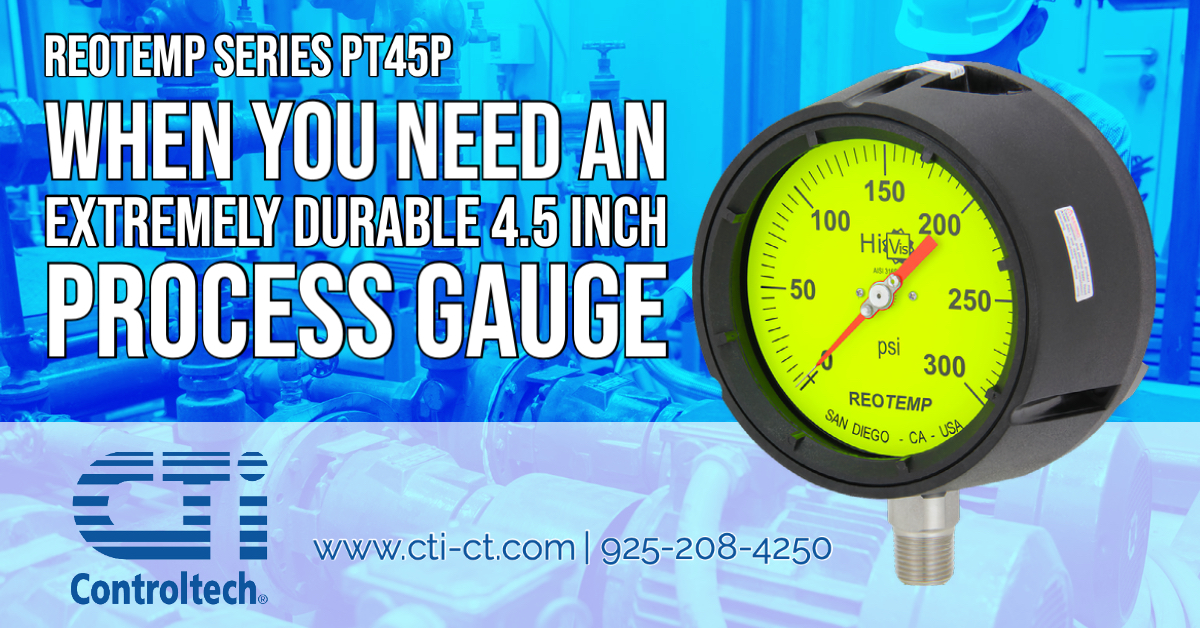
When You Need an Extremely Durable 4.5 Inch Process Gauge

When You Need an Extremely Durable 4.5 Inch Process Gauge

The Series PT45P process gauge from REOTEMP is an exceptionally durable gauge that can withstand pulsation and vibration, as well as corrosive atmospheres and media. It was built specifically for use in the process industries. The combination of the solid front and the blowout back provides a very high level of user safety. Note: A diaphragm seal should be installed for any highly corrosive application, operates at high temperatures, or put through strenuous use.

For more information about REOTEMP products in Northern California and Northwestern Nevada, contact CTi Controltech by calling 925-208-4250 or visit https://cti-ct.com.

Control Valve Application Notes

Control Valve Application Notes

Using an incorrectly applied or sized control valve may have significant ramifications for operation, productivity, and, most importantly, safety. Here is a brief list of fundamentals to consider: 

Control valves are not isolation valves: 

Control valves do not isolate a process and do not offer a bubble-tight seal, and utilization in a shutoff capacity is unwise. 

Choose the suitable materials for the job: 

The valve body, seat, and wetted materials must all be compatible with the process under control. Before selecting a valve, evaluate the pressure ratings, operating temperatures, and material compatibility. 

Sensor placement: 

Place the flow sensor upstream of the control valve when configuring the control loop. When the flow sensor placement is downstream of the control valve, exposure to an unstable fluid (bubbles) created by the flashing and turbulence of the flow in the valve cavity is possible.

Control precision and mechanical constraints: 

Consider the degree of controllability you need and the inherent Deadband produced by your valve and associated components. Deadband is the built-in movement that occurs in a control valve between the signal change and the direction of the valve, which exacerbates by worn or poorly designed couplings between valve and actuator, mechanical sensor tolerances, friction in the valve stems and seats, or an undersized actuator. Due to opening/closing oscillations, too much deadband leads to poor controllability (hunting). 

Stiction: 

Stiction is the "stickiness" in valve action induced by packing gland, seat, or force against the disk friction. It may happen if the valve sticks in one position for a prolonged time or is constantly traveling in a minimal range for an extended period. The actuator must apply more force to break the disk free, resulting in overshoot and poor control. 

Tuning the loop controller and/or positioner: 

A poorly configured loop controller or positioner is often the source of poor control and loop instability. Advanced auto-tuning capabilities in PI (proportional with integral), PD (proportional with derivative), and PID (proportional with integral and derivative) controllers have replaced human (often trial and error) loop tuning. 

Valve sizing should be correct: 

Control valves are often oversized, permitting maximum flow at just a tiny percentage of total travel. Minor adjustments in valve position have a significant impact on flow. A high valve-position-to-flow ratio promotes continual "hunting," which leads to excessive valve wear. A decent rule of thumb is to size a control valve at around 70% to 90% of its travel. 

What sort of flow characteristics does your valve produce: 

The flow characteristic of a control valve is the connection between the position of the valve disk, gate, or globe and the change in flow rate through the valve under normal circumstances. A linear flow characteristic is desirable. However, different valve designs have varying flow characteristics, some of which are linear and others that are not. Globe control valves have linear flow properties, while butterfly and gate valves have non-linear flow characteristics. Manufacturers will often create specifically shaped disks or orifices to "characterize" the valve's flow to improve linearity.

The above is a brief list of the most common things to consider when applying control valves. There are many other criteria to consider. It is suggested in the strongest terms to consult with an experienced application expert before selecting or using a control valve.

Process Measurement, Valve, and Combustion Experts Serving Northern California and Nevada

Process Measurement and Control Solutions

CTi Controltech contributes a wealth of knowledge, experience, and skill in their customer engagements. The items we carry come from globally recognized manufacturers and are used in conjunction with our contracting and engineering resources to provide complete solutions to our customers' problems. A leading provider of valves, valve actuation, emissions control, and monitoring systems for industrial burners and boilers. CTi Controltech also provides custom SCR systems as well as steam management solutions. CTi Controltech, headquartered in San Ramon, California, serves Northern California and Nevada. We design solutions to the problems that our customers experience daily in process control.

Combustion, Emission and Steam Solutions 

  • Low and ultra low NOx burners and burner retrofits 
  • BMS and CMS system design and hardware 
  • Custom design SCR Systems 
  • Burner air fuel mix recalibration 
  • Pre-emission test and boiler tune-ups 
  • Heat rate, efficiency studies and plant improvement 
  • Vapor recovery 
  • Particulate and CO2 control 

Process Control and Combustion Services 

  • Factory trained service personnel 
  • Commissioning and startup technical support 
  • Technical seminars and training 
  • Valve and actuator calibration and startup 
  • Instrument calibration and startup 
  • Complete turnkey project capabilities 
  • U.L. 508 custom design 
  • Project CAD drawings 
  • PLC Programming 
  • CFD and modeling 

Process Control Instrumentation Solutions 

  • Flow, level, pressure, density and temperature

Valve, Actuation, and Automation Solutions 

  • Severe service valve sizing and selection 
  • Valve and actuation packages, pneumatic, hydraulic and electric 
  • Noise and cavitation control 
  • Total valve management programs 
  • Turbine by-pass 
  • Desuperheating and attemperation 
  • Damper drives 
  • Check valves 
  • Vent to atmosphere and silencers 
  • Best fit for purpose replacement recommendations 
  • Ease of operation and life cycle cost considerations 

Pressure Relief and Flame Mitigation Technology

  • Pressure/Vacuum Relief Valves 
  • Pressure Relief Valves 
  • Vacuum Relief Valves 
  • Pilot Operated Valves 
  • Flame and Detonation Arresters 
  • Emergency Relief Valves 
  • Waste Gas Burners 
  • Pressure Regulators  
https://cti-ct.com
925-208-4250

Linear and Quarter-turn Industrial Valves

Linear and Quarter-turn Industrial Valves

Various valves are designed and used for multiple roles in process control. Linear and quarter-turn valves are two types of valves used to regulate and control fluid flow in the industry. Their design and construction reflect the intended use of the valves, with each suited to a different class of service. 

All valves work by controlling the position of an internal structure that obstructs fluid passage to some extent. In general, fluid flow at the valve classifies as unrestricted (valve fully open), stopped (valve fully closed), or throttled (valve partially open). The operational requirements of the process will determine whether only two of those conditions (fully open and fully closed) or all three are required. When choosing an appropriate valve, the fluid, the process, and the surrounding environment must be considered. It is not always a simple task. 

Linear valves distinguish themselves using straight-line motion to position the valve plug, disc, diaphragm, or other flow controlling elements. The linear valve trim's shape, size, and arrangement provide the operator with a flow range through the valve. The linear valve's positioning allows it to regulate fluid flow slower but more accurately. Linear motion valves include gate and fixed cone valves—linear valves best suit flow control.

Quarter turn valves move from fully open to closed by rotating a shaft connected to the controlling element 90 degrees. Their relatively simple operation allows for a rugged and compact design. The ability of quarter-turn valves to quickly reposition from open to closed positions is one of their distinguishing features. The torque required to operate the valves is typically low to moderate. Quarter turn valves include ball and butterfly valves. 

Depending on the situation, linear valves and quarter-turn valves are the best choices for specific process environments. The linear valve's accuracy and ability to move in a linear fashion rather than a quarter-turn come with easy maintenance and a lower likelihood of cavitation. Both valve types are widely used and are not competing for the same application. Each excels in a specific set of applications.

https://cti-ct.com
925-208-4250

Alfa Laval's Unique Mixproof 3-Body Sanitary Valve

Alfa Laval's unique Mixproof 3-Body valves allow for the simultaneous flow of two different products or fluids through the same valve without the risk of cross-contamination. The valve also includes a changeover function. 

The Mixproof 3-Body valve offers optimal process flow, exceptional hygiene, maximum uptime, and a low total cost of ownership. Its modular, three-valve-body design ensures reliable fluid handling and safety, making it ideal for use as a hygienic changeover valve. The Mixproof 3-Body valve translates into significant cost savings and increased efficiency.

FEATURES:

  • Operating spillage-free
  • Simplified maintenance
  • High level of hygiene
  • Outstanding safety level
  • Based on proven platform

Alfa Laval manufactures sanitary valves and automation. Customers trust Alfa Laval valves in the food, biopharma, life science, pharmaceutical, and cosmetic industries for process performance and hygiene in the most demanding applications.

For more information about Alfa Laval valve products in Northern California and Northwestern Nevada, contact CTi Controltech by calling 925-208-4250 or visit https://cti-ct.com.

Flowserve Valve, Actuation and Instrumentation Product Portfolio

Flowserve Valve, Actuation and Instrumentation Product

DOWNLOAD HERE

Flowserve offers a comprehensive range of quarter-turn, rotary, linear, control, and specialty configurations. Every valve manufactured is built with unwavering performance, long service life, and safe operation in mind. Flowserve also provides precision actuation and instrumentation for all applications, including remotely controlled, fully-automated electric, hydraulic, and pneumatic actuators, as well as electronic positioners and level switches. In most hazardous environments, fail-safe isolation, on-off modulation, and precision process control ensure efficient and reliable operation. Every intelligent flow control solution provides industry-leading performance and reliability, with embedded technologies that make them simple to use and maintain. You'll get end-to-end intelligence that maximizes your uptime by combining our control solutions with real-time system analysis, predictive maintenance, and remote service capabilities.

CTi Controltech Proudly Representing BS&B Safety Systems in Northern California and Nevada

CTi Controltech Proudly Representing BS&B

Since designing the first rupture disk (bursting disc) in 1931, BS&B Safety Systems, continues to set the standard for pressure release and flame suppression products. Their experienced engineering staff and certified craftsmen assure you of a reliable, cost effective, technologically advanced, code compliant product. 

BS&B Safety Systems manufacturing facilities operate and test according to national, international standards and codes including ASME VIII, AD Merkblatt A1 and EN ISO 4126-2: Bursting disc safety devices. Don't settle for an imitation - use BS&B rupture disks, explosion vents, pressure relief valves, and related safety products. 

BS&B Product Include:

  • Rupture Disks (Bursting Discs)
  • Graphite Disks
  • Safety Heads
  • Explosion Vents
  • Sensors & Monitors
  • Buckling Pin Relief Valves
  • Explosion Vents
  • Sensors & Monitors
  • Safety Relief Valves
  • Flame Arresters

CTi Controltech represents BS&B products in Northern California (the counties north of and including Monterey, Kings, Tulare and Inyo) and Nevada (the counties north of and including Esmeralda, Mineral, Churchill, Lander, Eureka and White Pines).

https://cti-ct.com
925-208-4250
CTi Controltech Is Now an Alfa Laval Valve Distributor

CTi Controltech Is Now an Alfa Laval Valve Distributor

CTi is now distributing Alfa Laval valve products in Northern Califonia and Western Nevada. 

Alfa Laval manufacturers valves and automation for hygienic use. Customers in the food, biopharm, life science, pharmaceutical, and cosmetic industries rely on Alfa Laval valves for process performance and hygiene in the most demanding applications.

Products distributed include:
  • Ball valves
  • Butterfly valves
  • Control/check valves
  • Diaphragm valves
  • Double seal valves
  • Double seat valves
  • Regulating valves
  • Safety valves
  • Sample valves
  • Shutter valves
  • Single seat valves
For more information contact CTi Controltech by calling 925-208-4250 or visit https://cti-ct.com.

Valve Positioners

Valve Positioners

Valve positioners perform the function of determining the error between the optimum vale position and actual valve position and provide a corrective output. Specialized sensors on the valve stem or shaft correspond to the setpoint from the control system. The positioner's output is sent electrically or pneumatically to a valve actuator, which moves the valve in the corrective direction. 

As a control valve accessory and the interface between the control system and valves, positioners play a vital role in ensuring the process loop's performance. The valve positioner adjusts the valves' opening, thereby varying the valve's flow rates, from completely shut or wide open to anywhere in between. 

Flowserve Corporation is a leading provider of flow control products and services for the global infrastructure markets, which offers a broad selection of analog, digital, and SMART positioners. For more information about Flowserve positioners in Northern California, contact CTi Controltech. Call them at 925-208-4250 or visit their website at https://cti-ct.com.

The Flowserve Valtek FlowTop GS Control Valve

The Valtek FlowTop GS control valve (types V746 and V748) improves the reliability and uptime of production processes while minimizing operating and maintenance costs. Designed for general service applications, the FlowTop GS globe valve is a competitively priced, fully integrated valve-actuator-instrumentation package for continuous process flow loop control throughout the plant.

For more infomration about Flowserve Valtek products in Northern California and Western Nevada, contact CTi Controltech. Call them at 925-208-4250 or visit their website at https://cti-ct.com.

CTi Appointed Authorized Distributor for Crane Products including Xomox, Flowseal, Aloyco, and Duo-Chek

CTi Controltech Providing Crane CPE
CTi Controltech is proud to announce that effective October 20, 2020 the appointment of CTi Controltech as and authorized Distributor for Xomox sleeved and lined plug valves, Flowseal high performance butterfly valves, and other Crane valve products such as Crane cast steel, bronze & iron, Aloyco SS valves, and Duo-Chek wafer check valves.

CTi Controltech
https://cti-ct.com
925-208-4250
PBM Cryogenic Ball Valves

PBM cryogenic valves have a unique design that provides superior performance through cooling and heating cycles. The valves have been shown to meet leakage criteria per MSS SP-134.

An extended bonnet with an upper set of live loaded stem packings. As metal shrinks, it keeps pressure on seals as temperature goes through cooling and heating cycles. The vented ball allows explosive gas expansion to vent upstream.

Cryogenic valves are optimally oriented with the stem 90° from the horizontal plane. PBM cryogenic valves are capable of operating with the stem oriented as low as 45° above the horizontal plane.

PBM Cryogenic CTi Controltech

PBM Cryogenic  Ball Valve

  • Sizes 1/2” - 4” - Full port. Consult PBM for additional sizes.
  • Temperatures from 400 ̊ F, 205 ̊ C down to -320 ̊ F, -200 ̊ C Live-loaded stem packings
  • Firesafe to API 607 Rev. 6
  • Designed and tested in accordance with ASME B31.1 and B16.34.
  • Materials of construction: stainless steel, other materials available – consult PBM for details.
  • Pressures to 1440 psi CWP (ANSI 600# class)
  • Cleaned for oxygen service.
  • Quarter turn operation
  • Locking lever handle or optional oval locking handwheel Automation available.
  • V-TEFTM seats/graphite seals
  • Internal and external grounding
  • Uni-directional flow and vented ball
  • Optional API-622 Low-e Packing (cannot be LOX cleaned)

For more information about PBM valve products in Northern California or Western Nevada contact CTi Controltech. Call them at 925-208-4250 or visit their website at https://cti-ct.com.

Commissioning the ROTORK CK Range Valve Actuators


The Rotork CK actuator range has been designed to meet the needs of diverse actuation applications required by the valve industry and its customers. The modular design concept enables quick product configuration from stock to customer specification with a very short lead time. 

The CK range provides the customer with a range of options to suit all of their actuation requirements. Rotork CK actuators are designed for minimum user interaction. Their primary goal is to provide safe and reliable actuation in harsh environments. 

The modular CK product range offers simple, robust actuators (CK/CKr) suited to harsh environments with the option for two different control packages (Atronik and Centronik) to meet exact site requirements. Atronik offers modest control and feedback for a simple integrated starter solution. Centronik offers advanced control and feedback for more complex site system integration and increased flexibility through remote mounting. 

For questions about all ROTORK products in Northern California and Nevada, contact CTi Controltech.

https://cti-ct.com
925-208-4250

Combined Groth Corporation Product Catalog: Valves & Tank Equipment, Pilot Operated Relief Valves, Combination Valve & Flame Arresters

Groth Corp Products


Groth Corporation is a global leader in manufacturing a wide range of low pressure relief products like pressure and vacuum relief valves, flame and detonation arresters, and blanket gas regulators.

This is a combined product catalog that includes; Combination Valve & Flame Arresters, Valves & Tank Equipment, and Pilot Operated Relief Valves.


For mor information about Groth Corporation products in Northern California or Western Nevada, contact CTI Controltech. Contact them by calling 925-208-4250 of visit their site at https://cti-ct.com.