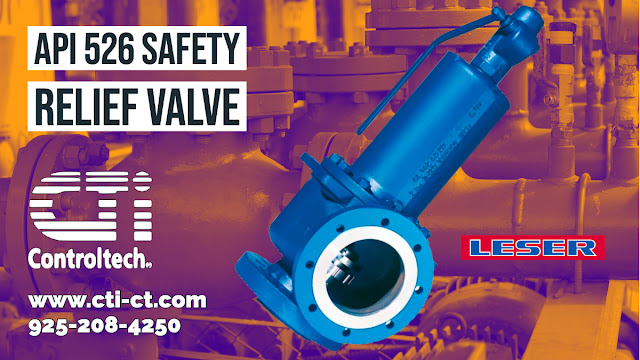
Here's a detailed explanation of spring-loaded and pilot-operated safety valves and their industrial uses.
Spring-Loaded Safety Valves
- Description: These safety valves feature a simple, self-contained design consisting of a valve body, a valve seat, a disc (or poppet), a spring, and an adjustment screw. The spring actively exerts a force on the disc, keeping it pressed against the valve seat and the valve closed under normal operating conditions. You can adjust the spring tension using the adjustment screw, enabling customization of the set pressure of the valve.
- Operation: When the system pressure exceeds the set pressure, the pressure forces the disc away from the valve seat by overpowering the spring force, opening the valve, and allowing excess pressure to vent out. Once the system pressure drops below the set pressure, the spring forces the disc back onto the seat, closing the valve.
- Applications: Industries use spring-loaded safety valves in various applications such as boilers, pressure vessels, and different piping systems, especially where the fluid is gas or steam. These valves respond quickly to sudden increases in pressure.
- Advantages: Spring-loaded safety valves are self-contained, straightforward, and reliable. They operate without the need for any external control or power supply.
- Disadvantages: These valves have limited capacity, might not handle extreme pressure fluctuations effectively, and can suffer from issues like "chattering" (rapid opening and closing), which can damage the valve.
Pilot-Operated Safety Valves
- Description: Pilot-operated safety valves are more intricate than spring-loaded valves. They comprise two main components: a main valve and a pilot valve. System pressure and a smaller spring close the main valve, acting on a larger surface area. The pilot valve, essentially a small spring-loaded safety valve, controls the opening and closing of the main valve.
- Operation: When system pressure surpasses the set pressure, the pilot valve opens first, reducing the pressure on top of the main valve. This action opens the main valve, venting the excess pressure. As the system pressure drops below the set pressure, the pilot valve closes, and the main valve reseals.
- Applications: Industries commonly use these valves in high-capacity and high-pressure applications such as chemical processing plants, power plants, and oil and gas facilities. They are ideal for liquid-based applications because they can handle large pressure fluctuations and higher flow capacity.
- Advantages: Pilot-operated safety valves offer greater capacity, improved performance with liquids, and increased stability compared to spring-loaded valves. They can accommodate more significant pressure fluctuations and are less susceptible to chattering.
- Disadvantages: These valves are more complex and costly compared to spring-loaded valves. They might also need periodic maintenance to ensure proper functioning.
Both types of safety valves play a crucial role in maintaining safe operating conditions in industrial systems. They prevent equipment damage and protect workers from potentially dangerous situations. The choice between spring-loaded and pilot-operated safety valves depends on the application's specific needs, such as the fluid type, operating pressure, and flow capacity.
CTi Controltech
925-208-4250