Showing posts with label process measurement. Show all posts

Wireless Transmitters In Process Measurement and Control

oil refinery
Industrial process instrumentation connectivity can present
substantial challenges.
In process control, various devices produce signals which represent flow, temperature, pressure, and other measurable elements of the process. In delivering the process value from the measurement point to the point of decision, also known as the controller, systems have traditionally relied on wires. More recently, industrial wireless networks have evolved, though point-to-point wireless systems are still available and in use. A common operating protocol today is known as WirelessHART™ , which features the same hallmarks of control and diagnostics featured in wired systems without any accompanying cables.

Wireless devices and wired devices can co-exist on the same network. The installation costs of wireless networks are decidedly lower than wired networks due to the reduction in labor and materials for the wireless arrangement. Wireless networks are also more efficient than their wired peers in regards to auxiliary measurements, involving measurement of substances at several points. Adding robustness to wireless, self-organizing networks is easy, because when new wireless components are introduced to a network, they can link to the existing network without needing to be reconfigured manually. Gateways can accommodate a large number of devices, allowing a very elastic range for expansion.

In a coal fired plant, plant operators walk a tightrope in monitoring multiple elements of the process. They calibrate limestone feed rates in conjunction with desulfurization systems, using target values determined experientially. A difficult process environment results from elevated slurry temperature, and the associated pH sensors can only last for a limited time under such conditions. Thanks to the expandability of wireless transmitters, the incremental cost is reduced thanks to the flexibility of installing new measurement loops. In regards to maintenance, the status of wireless devices is consistently transmitted alongside the process variable. Fewer manual checks are needed, and preventative measures may be reduced compared to wired networks.

Time Synchronized Mesh Protocol (TSMP) ensures correct timing for individual transmissions, which lets every transmitter’s radio and processor ‘rest’ between either sending or receiving a transmission. To compensate for the lack of a physical wire, in terms of security, wireless networks are equipped with a combination of authentication, encryption, verification, and key management. The amalgamation of these security practices delivers wireless network security equal to that of a wired system. The multilayered approach, anchored by gateway key-management, presents a defense sequence. Thanks to the advancements in modern field networking technology, interference due to noise from other networks has been minimized to the point of being a rare concern. Even with the rarity, fail-safes are included in WirelessHART™.

All security functions are handled by the network autonomously, meaning manual configuration is unnecessary. In addition to process control environments, power plants will typically use two simultaneous wireless networks. Transmitters allow both safety showers and eyewash stations to trigger an alarm at the point of control when activated. Thanks to reduced cost, and their ease of applicability in environments challenging to wired systems, along with their developed performance and security, wireless industrial connectivity will continue to expand.

Share your process measurement requirements and challenges with application specialists, combining your own process knowledge and experience with their product application expertise to develop effective solutions.


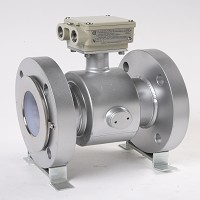
Operating Principles and Application of Vortex Flowmeters

vortex flow meter for steam gas or liquid
Vortex Flow Meter
Courtesy Azbil NA
To an untrained ear, the term “vortex flowmeter” may conjure futuristic, potentially Star Wars inspired images of a hugely advanced machine meant for opening channels in warp-space. In reality, vortex flowmeters are application specific, industrial grade instruments designed to measure an important element of a fluid process control operation: flow rate.

Vortex flowmeters operate based on a scientific principle called the von Kármán effect, which generally states that a fluid flow will alternately shed vortices when passing by a solid body. “Vortices” is the plural form of vortex, which is best described as a whirling mass, notably one in which suction forces operate, such as a whirlpool. Detecting the presence of the vortices and determining the frequency of their occurrence is used to provide an indication of fluid velocity. The velocity value can be combined with temperature, pressure, or density information to develop a mass flow calculation. Vortex flowmeters exhibit high reliability, with no moving parts, serving as a useful tool in the measurement of liquid, gas, and steam flow.

While different fluids present unique challenges when applying flowmeters, steam is considered one of the more difficult to measure due to its pressure, temperature, and potential mixture of liquid and vapor in the same line. Multiple types of steam, including wet steam, saturated steam, and superheated steam, are utilized in process plants and commercial installations, and are often related to power or heat transfer. Several of the currently available flow measurement technologies are not well suited for steam flow applications, leaving vortex flowmeters as something of a keystone in steam flow measurement.

Rangeability, defined as a ratio of maximum to minimum flow, is an important consideration for any measurement instrument, indicating its ability to measure over a range of conditions. Vortex flowmeter instruments generally exhibit wide rangeability, one of the positive aspects of the technology and vortex based instruments.

The advantages of the vortex flowmeter, in addition to the aforementioned rangeability and steam-specific implementation, include available accuracy of 1%, a linear output, and a lack of moving parts. It is necessary for the pipe containing the measured fluid to be completely filled in order to obtain useful measurements.
Applications where the technology may face hurdles include flows of slurry or high viscosity liquids. These can prove unsuitable for measurement by the vortex flowmeter because they may not exhibit a suitable degree of the von Kármán effect to facilitate accurate measurement. Measurements can be adversely impacted by pulsating flow, where differences in pressure from the relationship between two or more compressors or pumps in a system results in irregular fluid flow.

When properly applied, the vortex flowmeter is a reliable and low maintenance tool for measuring fluid flow. Frequently, vortex flow velocity measurement will be incorporated with the measurement of temperature and pressure in an instrument referred to as a multivariable flowmeter, used to develop a complete measurement set for calculating mass flow.

Whatever your flow measurement challenges, share them with a flow instrument specialist, combining your process knowledge with their product and technology expertise to develop effective solutions.

Introduction to Flowmeters

magnetic-flow-meter-flowmeter
Electromagnetic Flow Meter
Courtesy Azbil N.A.
Flowmeters measure the rate or quantity of moving fluids, in most cases liquid or gas, in an open channel or closed conduit. There are two basic flow measuring systems: those which produce volumetric flow measurements and those delivering a weight or mass based measurement. These two systems, required in many industries such as power, chemical, and water, can be integrated into existing or new installations. For successful integration, the flow measurement systems can be installed in one of several methods, depending upon the technology employed by the instrument. For inline installation, fittings that create upstream and downstream connections that allow for flowmeter installation as an integral part of the piping system. Another configuration, direct insertion, will have a probe or assembly that extends into the piping cross section. There are also non-contact instruments that clamp on the exterior surface of the piping and gather measurements through the pipe wall without any contact with the flowing media.

Because they are needed for a variety of uses and industries, there are multiple types of flowmeters classified generally into four main groups: mechanical, inferential, electrical, and other.

Quantity meters, more commonly known as positive displacement meters, mass flowmeters, and fixed restriction variable head type flowmeters all fall beneath the mechanical category. Fixed restriction variable head type flowmeters use different sensors and tubes, such as orifice plates, flow nozzles, and venturi and pitot tubes.

Inferential flowmeters include turbine and target flowmeters, as well as variable area flowmeters also known as rotameters.

Laser doppler anemometers, ultrasonic flowmeters, and electromagnetic flowmeters are all electrical-type flowmeters.

The many application classes throughout the processing industries have led to the development of a wide range of flow measurement technologies and products. Each has its own advantages under certain operating conditions. Sorting through the choices and selecting the best technology for an application can be accomplished by consulting with a process instrumentation specialist. The combination of your own process knowledge and experience with their product application expertise will develop an effective solution.

Advanced Pressure Transmitters for Process Measurement

pressure transmitter for industrial process measurement
Direct mount pressure transmitter
Courtesy Azbil
The measurement of pressure is a common task throughout many industrial spheres. Depending on the application, a wide range of process or machinery operation status can be derived from a pressure reading. Accuracy, ruggedness, and flexibility in application are hallmarks of a useful pressure transmitter.

Azbil North America advanced pressure transmitters offer a combination of features that can make them an advantageous selection for almost any application.

  • Stability of +/-0.1% for 10 years
  • Little to no downtime for calibration
  • Sensor technology that provides day-one accuracy for the life of the transmitter
  • Customizable display
  • Alarm outputs
  • Fast response
  • International standard certifications
The advanced pressure transmitter is available in variety of mounting configurations to suit most applications. More information is contained in the document included below. Share your process measurement challenges with application experts, combining your own process knowledge and experience with their product application expertise to develop effective solutions.


Vortex Gas Flowmeter With Built-in Pressure and Temperature Compensation

Vortex flowmeter for gas with built-in temperature and pressure compensation
Azbil MVF Series Vortex Gas Flowmeter
Industrial process control operations require measurement, lots of measurement. Whether it be temperature, level, flow, pressure, or some other attribute of the process, manufacturers have always responded to customer demand with a broad array of engineered products geared toward higher performance and lower cost.

Combining related measuring functions or capabilities into a single device can result in space and cost savings, as well as simplifying maintenance operations. Azbil NA does just that with their MVF Series of vortex flowmeters for gases.

Vortex flowmeters are based upon the recognized principle of vortices being generated downstream of a blunt obstruction at a frequency dependent upon the velocity of the fluid (von Kármán effect). The fluid velocity can be combined with temperature and pressure measurements to produce a calculated mass flow. Azbil, in their MVF Series, provides built in compensation for temperature and pressure, eliminating the need for additional instrumentation. The vortex gas flowmeter provides an output signal that is proportional to the mass flow, as well as a pulse signal. The flowmeter is suitable for use with air, nitrogen, argon, oxygen, carbon dioxide, city gas (13A), methane, propane, butane, and other inert gases or mixtures outside the explosion limit range.

See the data sheet below for more detail. You can also contact product application specialists for any assistance needed to select the right configuration for your application. Share your process measurement and control challenges with product experts. Combine your process expertise with their product application knowledge to produce the most effective solutions.


Understand These Areas of Process Instrument Protection

process measurement instruments
Properly protect process measurement instrumentation
to prevent mishap 
The performance of every process is critical to something or someone. Keeping a process operating within specification requires measurement, and it requires some element of control. The devices we use to measure process variables, while necessary and critical in their own right, are also a possible source of failure for the process itself. Lose the output of your process instrumentation and you can incur substantial consequences ranging from minor to near catastrophic.

Just as your PLC or other master control system emulates decision patterns regarding the process, the measurement instrumentation functions as the sensory input array to that decision making device. Careful consideration when designing the instrumentation layout, as well as reviewing these five common sense recommendations will help you avoid instrument and process downtime.

Process generated extremes can make your device fail.


Search and plan for potential vibration, shock, temperature, pressure, or other excursions from the normal operating range that might result from normal or unexpected operation of the process equipment. Develop knowledge about what the possible process conditions might be, given the capabilities of the installed process machinery. Consult with instrument vendors about protective devices that can be installed to provide additional layers of protection for valuable instruments. Often, the protective devices are simple and relatively inexpensive.

Don't forget about the weather.


Certainly, if you have any part of the process installed outdoors, you need to be familiar with the range of possible weather conditions. Weather data is available for almost anywhere in the world, certainly in the developed world. Find out what the most extreme conditions have been at the installation site....ever. Planning and designing for improbable conditions, even adding a little headroom, can keep your process up when others may be down.

Keep in mind, also, that outdoor conditions can impact indoor conditions in buildings without climate control systems that maintain a steady state. This can be especially important when considering moisture content of the indoor air and potential for condensate to accumulate on instrument housings and electrical components. Extreme conditions of condensing atmospheric moisture can produce dripping water.

Know the security exposure of your devices.


With the prevalence of networked devices, consideration of who might commit acts of malice against the process or its stakeholders, and how they might go about it, should be an element of all project designs. A real or virtual intruder's ability to impact process operation through its measuring devices should be well understood. With that understanding, barriers can be put in place to detect or prevent any occurrences.

Physical contact hazards


Strike a balance between convenience and safety for measurement instrumentation. Access for calibration, maintenance, or observation are needed, but avoiding placement of devices in areas of human traffic can deliver good returns by reducing the probability of damage to the instruments. Everybody is trained, everybody is careful, but uncontrolled carts, dropped tools and boxes, and a host of other unexpected mishaps do happen from time to time, with the power to inject disorder into your world. Consider guards and physical barriers as additional layers of insurance.

Know moisture.


Electronics must be protected from harmful effects of moisture. Where there is air, there is usually moisture. Certain conditions related to weather or process operation may result in moisture laden air that can enter device enclosures. Guarding against the formation of condensate on electronics, and providing for the automatic discharge of any accumulated liquid is essential to avoiding failure. Many instrument enclosures are provided with a means to discharge moisture. Make sure installation instructions are followed and alterations are not made that inadvertently disable these functions.

Developing a thoughtful installation plan, along with reasonable maintenance, will result in an industrial process that is hardened against a long list of potential malfunctions. Discuss your application concerns with your instrument sales engineer. Their exposure to many different installations and applications, combined with your knowledge of the process and local conditions, will produce a positive outcome.

Innovative Magnetic Level Gauge Provides Accurate Indication Under Adverse Conditions

Jerguson Magnetic Level Gauge
Magnetic Level Gauge on Tank
Courtesy Jerguson
We, as engineers, industrial process operators and stakeholders, recognize the necessity and value of a continuous stream of accurate and timely information about our processes. Our experience has also taught us that the environment and activities surrounding our installations can have a significant impact upon our ability to continually gather accurate process measurements. Some of our concerns include:

  • Weather - An element whose impact cannot be understated....or easily predicted.
  • Physical Contact - Equipment and measurement devices must be protected from damaging impact.
  • Security - Vandalism, cyber invasion, and other external threats are possible

Our responsibility, as operators of machines and handlers of materials that can produce hazardous or life threatening conditions in the case of failure or error, is to foresee every reasonably probable event that could adversely impact the safe and proper operation of our industrial processes.

One manufacturer has developed an innovative solution to a potential problem in the application of magnetic level controls.

The short video below outlines the source of the potential failure and the way in which the product design change successfully overcomes a potentially adverse impact on process measurement. Invest less than three minutes of your time to watch the video and build your application knowledge by learning from the experience of others. Do not hesitate to contact a product application specialist for more detail, or to discuss your process measurement needs.